
ALHAMBRA ARCHITECTURE
About the Alhambra
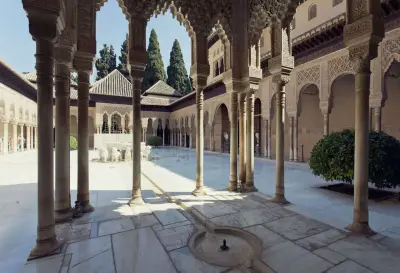
The Alhambra is a remarkable example of Islamic architecture, known for its detailed designs, brightly colored tiles, and carved walls that present the spirit of its time. It blends Islamic, Christian, and Renaissance styles, showing the cultural diversity of medieval Spain. Situated on a hill overlooking Granada and the Darro River, the Alhambra has an uneven shape, bordered by rivers and streets, and is surrounded by solid walls. With its elegant arches, impressive ceilings, and peaceful courtyards, this UNESCO World Heritage site reflects the skill and creativity of its builders.

Alhambra’s Royal Past
The Alhambra, originally a simple fortress from the 8th century, was transformed into a grand royal palace and fortress during the 13th and 14th centuries by the Nasrid dynasty rulers. It was designed both to protect the kingdom and to showcase the rulers’ wealth, power, and culture. The complex of buildings, which includes mosques, is known for its beautiful design with courtyards, fountains, and gardens, highlighting the wealth of the Nasrid Dynasty. The Alhambra represents the peak of Islamic culture in Spain before the Christian Reconquista, making it an important part of history.
Ready to explore the Alhambra?

Fast-track admission
Alhambra and Nasrid Palace Ticket
Visit the Alhambra and Nasrid Palaces, once home to the kings of Granada. Walk through the beautiful Generalife Gardens and see the Alcazaba, the Palace of Charles V, and the Mosque Baths. Skip the line and learn about Granada’s rich Moorish history, Islamic architecture, and cultural heritage.

Unique experience
Alhambra Night Ticket
Enjoy a peaceful night-time visit to the Alhambra, away from the busy daytime crowds. Walk through the stunning Generalife Gardens and explore the Nasrid Palaces. Whether you prefer the calm gardens or the unique architecture of the Moorish-style palaces, the Alhambra at night is an unforgettable experience.

Nasrid Palace
The Nasrid Palace is a beautiful example of Moorish architecture and a highlight of the Alhambra complex. It has three main sections: the Mexuar, used for administrative and judicial purposes; the Comares Palace, home to the sultan’s primary residence, the Hall of Ambassadors with its impressive dome; and the Palace of the Lions, known for its central courtyard with a lion fountain surrounded by arches. The Hall of Two Sisters, with its intricate muqarnas (a detailed honeycomb-like ceiling), was used for receptions or ceremonies and displayed some of the finest Islamic art and geometric designs, presenting the wealth and significance of the royal Alhambra. The intricate designs of the Nasrid Palaces are often compared to the Royal Alcázar in Seville. To see how the architectural heritage of these two cities differs, read our comparison of Seville vs. Granada.

Generalife Gardens
The Generalife Gardens were once a summer palace and getaway for the Moorish kings. Filled with green plants, colorful flowers, and water features, the gardens have a simple and elegant architectural design.
Open spaces, flowing water channels, and greenery create a calm and peaceful atmosphere. Fountains and pavilions are vital features, blending with nature and offering great views of the Alhambra Palace and nearby hills. The architecture reflects balance and harmony, symbolizing the Islamic idea of heaven on earth

Alcazaba
The Alcazaba, built in the 13th century by the Moors, is the oldest building in the Alhambra. It has a typical military design and simple structure with thick, double-stone walls, defensive towers, and narrow walkways for protection. Unlike the more decorative areas of the Alhambra, the Alcazaba was built for strength and defense, with watchtowers that provided important views of Granada.
Charles V Palace
Built after the Christian takeover in the 16th century, the Charles V Palace stands out from the rest of the complex with its large square shape and central circular courtyard. It clearly shows the change from the older Moorish style of architecture, reflecting Spain’s transition from Islamic to Christian rule. The square exterior and circular center display the Renaissance style of symmetry and harmony. The architectural design differs significantly from the detailed Islamic designs around it, adding a strong, classical element to the Alhambra complex.
Marble, stucco & wood
The Alhambra, meaning “the red castle”, got its name from the reddish color of its walls due to the iron-rich soil in Granada. It features stunning Islamic design, using materials like stucco for intricate walls, cedarwood for carved ceilings, marble for floors and columns, and colorful tiles. Plaster was also used for detailed ornamentation on the walls. Poetry is engraved on the walls and columns, while the ceilings, like in the Hall of Ambassadors, often display star designs. Stucco also creates lace-like patterns and ceilings decorated in honeycomb style. The materials and design of Alhambra reflect that period’s Islamic art and skills. Buildings like the De las Granadas Gate, Torre de las Infantas, Palacio de Comares, Puerta de las Granadas, and Patio de los Arrayanes combine decoration with functionality, ensuring that every available space is decorated.

Dual influence: Islamic & Christian styles
The Alhambra complex includes a group of medieval and Renaissance palaces and courtyards built inside a 13th-century fortress, designed like a small city with gardens, baths, prayer buildings, and water supplies. Both Muslim and Christian royalty lived there at different times, each leaving their mark. The Nasrid architecture, the last period of Islamic art in Spain, includes some typical Andalusian elements, such as the horseshoe arch and arch scallops, along with its own unique details, such as its special columns and the mocarabe vault, which has honeycomb-like cells seen in the Hall of the Abencerrajes and the Hall of the Two Sisters. Later Christian additions include Renaissance-style changes like frescoes and larger windows and buildings like the Palace of Charles V and the Church of Santa Maria, built on the site of the Great Mosque.
Want to learn more about the Alhambra architecture?

Skip-the-Line
Alhambra Guided Tour
Discover Alhambra's rich history with an expert guide. Explore the iconic Nasrid Palaces, walk through the beautifully landscaped Generalife Gardens, and enjoy panoramic views from the Alcazaba fortress. Get priority access and listen to fascinating stories from Alhambra’s medieval past. Visit the royal quarters and elegant courtyards and view the intricate carvings and detailed tilework for an unforgettable experience.

Private group
Alhambra Private Tour
Enjoy a personalized Alhambra experience with a private tour tailored to your group. Explore the iconic architecture at your own pace with an expert guide. Walk through the peaceful Generalife Gardens, visit the Court of the Lions, and learn about the interesting history of the Nasrid Palaces, a masterpiece of Islamic art and architecture. Visit the Alcazaba fortress for stunning views and skip the lines for a more relaxed, crowd-free visit.