
ALHAMBRA HISTORY – ORIGIN & HISTORICAL JOURNEY
The Alhambra: From fortress to iconic landmark
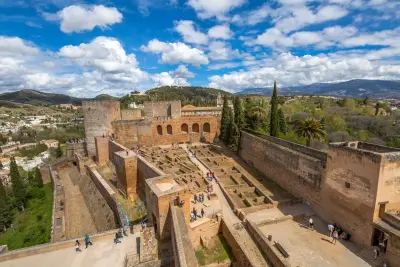
The Alhambra’s history dates back to the 11th century when the Berber Zirid dynasty renovated earlier Roman and Muslim fortifications. Its strategic location on top of the hill, overlooking the city of Granada and the Darro River, made it an important site long before the Nasrid dynasty transformed it into the iconic palace. Named after the Arabic “Al-Qal’a Al-Hamra”, meaning “The Red Castle”, for its reddish color, the Alhambra got its distinct look under Nasrid rule, symbolizing their wealth and power. Over the centuries, it evolved from a fortress to a royal palace, later becoming a neglected ruin and finally into one of Spain’s most iconic landmarks.

9th Century: The Alhambra’s first mention
The Alhambra was first mentioned in historical records in the 9th century when Sawwar ben Hamdun took refuge in the Alcazaba, a fortress on the site, during civil unrest in the Caliphate of Córdoba. He began repairing the existing structure, which led to some development in the area as it became more populated.
11th Century: A strategic fortress
The Ziri dynasty ruled Granada in the 11th century, making the Alhambra a military base. Alcazaba (in Arabic, the “Citadel”) was built by the Berber king Badis ibn Habus with solid walls and fortifications on Sabika Hill. Over the centuries, the Alcazaba was controlled by different dynasties, including the Almoravids and Almohads, before becoming part of the Nasrid Kingdom.

13th Century – From fortress to royal palace
The first Nasrid king, Mohammed ben Al-Hamar (Mohammed I), established his royal residence at the Alhambra, marking the beginning of its transformation from a fortress into a grand palatial complex. Surrounded by solid walls and watch towers, it offered wide views of Granada below, symbolizing the power and strength of the Nasrids during their rule. This marked the start of Alhambra’s most prosperous period, with stunning architectural and cultural developments.
14th Century – Alhambra’s golden era
In the 14th century, the Alhambra became an important cultural and political center under the Nasrid Dynasty. The complex underwent major reconstruction, with key additions like the Palace of the Lions ( Patio de los Leones) and the Comares Palace, which includes the Hall of Ambassadors ( Sala de los Embajadores). The Alhambra thrived as a place for art, poetry, and learning, with areas for relaxation like the Generalife Gardens, public baths, mosques and administrative areas like the Mexuar Hall. However, by the end of the century, the rise of Christian forces indicated that changes were coming to the region.

15th Century (1492) – The fall of the Alhambra & the end of Muslim rule
In 1492, the Catholic Monarchs Ferdinand and Isabella completed the Reconquista by capturing Granada and ending Muslim rule in Spain. The Nasrid ruler, Muhammad XII (Boabdil), surrendered the city and the Alhambra, marking the fall of the last Muslim kingdom in Spain. After the conquest, the Alhambra was changed to reflect the new rulers’ preferences, although most of the original Islamic art and architecture was preserved. Following the Reconquista, the Catholic Monarchs moved between the grand palaces of Granada and Seville, leaving a royal footprint on both. Today, choosing between visiting these two historic capitals can be difficult for any history lover. You can find a breakdown of what makes each city unique in our Seville vs. Granada guide.
16th Century – The transformation under Christian rule
The new Christian rulers wanted to leave their mark on the Alhambra, and in 1526, Charles V ordered the construction of a Renaissance-style palace, which stood in contrast to the existing Islamic architecture. With the fall of the Nasrid dynasty, the Alhambra lost its status as a royal residence and started to deteriorate. The once beautiful Islamic gardens were neglected, and the complex slowly lost its former greatness.

17th and 18th Centuries – Alhambra’s fall from glory
During the 17th & 18th centuries, the Alhambra continued to decline, primarily being used as military barracks. Much of its artwork suffered damage, and earthquakes made things worse. During the Napoleonic Wars (1808–1814), Napoleon’s forces occupied the Alhambra and tried to destroy parts of it with explosives. A local soldier managed to disarm some explosives, saving the main structures from destruction.
19th Century – The Alhambra’s revival
In the 19th century, the Alhambra regained attention after Washington Irving’s book “Tales of the Alhambra“ from 1832 described it as a magical place from a lost civilization. Restoration efforts followed to preserve the palace and restore its historical value.
20th Century – Restoration & global recognition
In the 20th century, the Alhambra was declared a national monument, and in 1984, it was named a UNESCO Heritage Site, along with the Generalife Gardens and the Albayzín. By the late 20th century, Alhambra became one of Spain’s top tourist destinations, with continuous efforts to protect its architecture for future generations.
The Alhambra today
The Alhambra remains a symbol of Moorish Spain, blending Islamic, Christian, and Renaissance influences. As a UNESCO World Heritage site, it attracts millions of visitors every year who admire its impressive architecture and learn about its historical significance.
Want to find out more about the Alhambra and its history?

Skip-the-Line
Alhambra Guided Tour
Discover Alhambra's rich history with an expert guide. Explore the iconic Nasrid Palaces, walk through the beautifully landscaped Generalife Gardens, and enjoy panoramic views from the Alcazaba fortress. Get priority access and listen to fascinating stories from Alhambra’s medieval past. Visit the royal quarters and elegant courtyards and view the intricate carvings and detailed tilework for an unforgettable experience.

Private group
Alhambra Private Tour
Enjoy a personalized Alhambra experience with a private tour tailored to your group. Explore the iconic architecture at your own pace with an expert guide. Walk through the peaceful Generalife Gardens, visit the Court of the Lions, and learn about the interesting history of the Nasrid Palaces, a masterpiece of Islamic art and architecture. Visit the Alcazaba fortress for stunning views and skip the lines for a more relaxed, crowd-free visit.